
Powerful science.
Purposeful design.
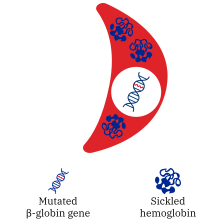
SICKLED RED BLOOD CELL2,3
A single mutation in the β-globin gene leads to the production of sickled hemoglobin (HbS) rather than adult hemoglobin (HbA).2
Red blood cells that contain high levels of HbS can undergo polymerization, become rigid, and become sickle shaped, leading to vaso-occlusive events, the hallmark of SCD.2,3
SICKLED RED BLOOD CELL2,3

A single mutation in the β-globin gene leads to the production of sickled hemoglobin (HbS) rather than adult hemoglobin (HbA).2
Red blood cells that contain high levels of HbS can undergo polymerization, become rigid, and become sickle shaped, leading to vaso-occlusive events, the hallmark of SCD.2,3

Mutated
β-globin gene

Sickled
hemoglobin
Overview of SCD and Prevalence of VOEs
Hear from clinical experts as they contextualize the burden of disease and discuss why VOE frequency remains central to treatment decision-making
Overview of SCD and Prevalence of VOEs
Hear from clinical experts as they contextualize the burden of disease and discuss why VOE frequency remains central to treatment decision-making

LYFGENIA is manufactured by
transducing autologous CD34+ cells with the BB305 lentiviral vector (LVV), which carries the βA-T87Q-globin gene1
Mutated β-globin gene

BB305 LVV

Following successful engraftment, red blood cells containing βA-T87Q-globin pair with α-globin to produce functional HbA (HbAT87Q)1

HbAT87Q reduces intracellular and total HbS levels and is designed to sterically inhibit polymerization of HbS, thereby limiting the sickling of red blood cells1

βA-T87Q-globin
gene

Functioning
HbA (HbAT87Q)
Mutated
β-globin gene
Sickled
hemoglobin
βA-T87Q-globin
gene
Functioning
HbA (HbAT87Q)
Mutated
β-globin gene
Sickled
hemoglobin

Confidence in every cell

The longest-studied viral vector platform in SCD:
Viral vectors are the most commonly used vehicle in FDA-approved cell and gene therapies, representing the predominant platform with the longest-standing safety data.8

A traceable vector:
A gene-addition therapy, LYFGENIA was engineered on a well-studied and traceable LVV platform that does not include the harmful viral genes that are required to cause HIV infection.5-7,9
Patients who have received LYFGENIA should not be screened for HIV infection using a PCR-based assay because they may have a false-positive test result if tested using a PCR assay.1,10 Other tests such as antigen tests or nucleic acid tests may be able to accurately assess a person’s HIV status.10
Understanding Viral Vectors
Thought leaders address common questions and discuss viral vectors
Understanding Viral Vectors
Thought leaders address common questions and discuss viral vectors